Showing posts with label bird. Show all posts

Friday, August 2, 2013

Mini Macaws

Just about every bird lover wants a macaw, but few people have the time or funds to devote to a huge, expensive bird- they can easily cost thousands of dollars, and an appropriately large cage will set you back several hundred bucks.

 Most people, when they think of macaws, invasion the large species: Blue and Gold, Greenwing, Scarlet, or Hyacinth. Less well known are the Mini Macaws.

The smallest member of the Macaw family is the Red-Shouldered Macaw- the two subspecies are the Hahn's Macaw and the Noble Macaw. These parrots are only 12-14 inches long- scarcely larger then the Cockatiel!

The largest Mini-Macaw is the Severe Macaw- and even it is only 18 inches long.


File:Severemacaw.jpg
This is a Severe Macaw


Mini-Macaws, like their larger counterparts, are extreamly intelligent birds that can learn to speak and do tricks.

Owners of these bird report that they act like the larger Macaws- some say that their size is the only "mini" thing! This is great for people that love the feisty Macaw personality, but it also means that they have some of the same "problems".

All Macaws are noisy birds. They also need hours of daily attention- which they will often demand by screaming. They also have large beaks for their size, that could still do some damage if they decided to use them.

A young Mini Macaw costs several hundred dollars, but usually under a thousand. An adult will cost less. They are not cheap parrots- most aren't- but compared to a large macaw (especially a Hyacinth Macaw) they cost a lot less.

If you want a Macaw, don't over look these less flashy, but still beautiful, birds.


Sunday, July 21, 2013

Lovebirds

I haven't been posting too much lately. A lot of things have been going on. Anyway, as you may have guessed from the title, the topic today with be "Lovebirds".

I will start with some pictures of these beautiful birds:


A mutation Peach-Faced Lovebird


Another mutation Peach-Face Lovebird


A normal Peach-Faced Lovebird


A Masked Lovebird and a Fisher's Lovebird

Lovebirds are beautiful small parrots that come in many different "mutations" or colors. The most common and the cheapest Lovebird is the Peach-Faced. Sometimes Masked or Fisher's Lovebirds are also kept as pets. Other species are rare in captivity.

Lovebirds rarely speak, so don't get one if having a talking bird is important to you. I have heard that Females are more likely to talk then males. I'm not sure if that is correct, as the reverse is true for most small bird species. 

Most people have heard that Lovebirds "need" a mate. Many people even believe that a Lovebird kept without a mate will die. That is not true, although, as with any bird, an already- bonded  pair should not be separated. Actually, a Lovebird will be friendlier and tamer if kept alone.

Lovebirds tend to be aggressive, so they should not be housed with other birds, including Budgies, except perhaps in a large aviary where the birds can fly away or hide from each other if necessary.

Lovebirds make great little pet birds. They are not too loud or too messy, and they are one of the most beautiful birds.

Thursday, August 2, 2012

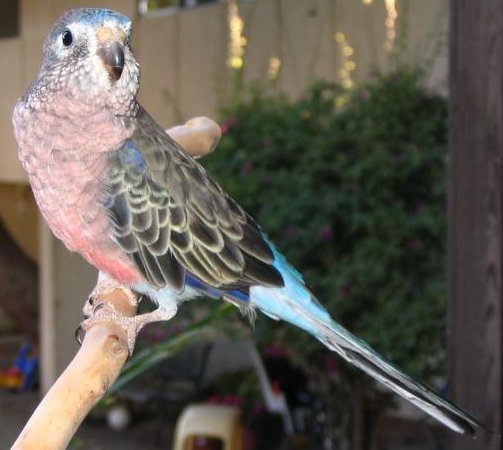
Bourke Parakeet

There is one type of parakeet that every one knows- the beautiful little budgie, but there are many other kinds of parakeet, such as the Bourke, Linoliated, and Mustached. This post is about Bourke Parakeets, one of the most common "other parakeets".

I have recently been reading the blog The Splendid Bourke Bird Blog, reading it got me interested in the Bourke Parakeet

The body shape of a Bourke is like that of a budgie, but the colors are different. One morph of the Bourke, called the Rosy is bright pink!

According the the author of The Splendid Bourke Bird Blog, Bourkes are quieter than Budgies.

Bourke Parakeets are not wildly expensive, about $50 - $150, depending of the morph.

A 'normal' Bourke Parakeet


Ok, so the picture is kind of blurry, but it's the only picture of the rare Lutino Bourke Morph I could find
I think this is a Rosy, but it might just be an especially pink Normal.

For more pictures check out that blog.

Saturday, July 28, 2012

A Playstand for Your Bird

A playstand (also called a jungle gym, playground, or playgym) is a great thing to get for your bird! It is basically a bunch of perches and ladders attached to a base. You can add toys and dishes to it, and it usually has a washable base. The bird can play on it and chew on it, and if the bird likes its playstand and will stay on it, you can put him on it and keep him out of trouble.

Kiki's playstand is a model made by Drs. Foster and Smith (a pet and vet supply company). The model I own is not currently sold from the website (I bought it at a yard sale) but there are some similar ones. The playstands made by that company are good ones, made with PVC and wood that Kiki loves to chew!

Get the bird used to the playstand by making it step off a perch on the the stand. Give the bird his favorite treat (Kiki loves millet) to eat when he is on there. If he flies off, quickly return him to the stand. Soon, your bird will like the stand and stop flying off.

Be sure to get a safe and sturdy playstand. If you don't have a playstand for your bird, I recommend that you go buy one!   

Wednesday, July 4, 2012

Raising Quail

Well, maybe you want to raise chickens but you don't have the space, it's not allowed (if you live the city), or you can't keep roosters but you want to raise chicks, or maybe you just want a fun and educational pet. If so, you could try raising quail.

Many websites like this one http://www.hometrainingtools.com/quail-eggs-incubators/c/161/ and other school/ home school science supply sites have chicks. For a rather low price ( $31 on this site) you get either four Pharaoh (also called Cortunix) or four Bobwhite quail eggs and an incubator.

It might seem hard to hatch chicks, but you can do it. First, since the eggs are dormant, you can leave them alone for about eight hours to 'settle'. The most important things to remember are: make sure the heat stays constant, keep it humid, and turn the eggs. You have to turn the eggs at least twice a day, but some people say every four hours. About four times a day should work.

It is recommended to mark an X on one side of the egg and O on the other. Also, you are less likely to damage the fragile eggs if you roll the eggs with your finger instead of picking them up to turn them.

When the chicks hatch, they will first poke a hole at the oxygen in - then sleep (they are exhausted), then they will peck some more, often sleeping. When they have hatched, leave them alone for at least eight hours or until they get active. Them, pick the chicks up carefully and but them in a brooder (a cardboard box or aquarium with a heat lamp, lined with newspaper or rodent shavings). Try not to handle them much for a few days (they are very, very, very tiny!).

After a few days, you can hold the chicks very gently (otherwise they will be very skittish when full grown).

Quail chicks can eat normal chick starter made for chicken chicks. My Aunt had quail as a girl, and she fed them oatmeal, I think. Chick starter is probably better.

When the chicks are full grown, they need a cage. They are small enough to keep indoors, and actually, many people do this. If you keep them indoors or in a garage or shed, you can use a wire guinea pig cage. Other wise, you can use a rabbit cage. Either way, they should have space to fly. Or, if the wings are clipped (for indoor quail and tame quail that you handle) they should have a run.

By the way, the website says that usually only two or three eggs hatch. If none of them hatch, you can get four more for two dollars.

The incubator is reusable, so if you have more eggs (if you have a cock and hen, you will have plenty) you can hatch them. If you want eating eggs, sell the cocks or keep them separate.


Saturday, June 16, 2012

Pets I've Met- Coral

Coral is a beautiful Moloccan Cockatoo. She is the mascot of Award Pet Supply, a pet store in Columbia Missouri.

Coral is very friendly. She, like many cockatoo breeds loves to be petted, but customers cannot pick her up because she has trouble keeping her balance. She walks with her feet turned inward.

She wasn't talking while we were there last time but she can. She can also make "kissing" noises, a sort of clicking sound, and whine like a dog.


I got some video of Coral.


Friday, May 18, 2012

Another Nest!

Well, a few days ago I noticed a mourning dove that kept flying out of a certain small bush. I finally found the nest: a tiny rather sloppy thing. As is characteristic of "mourners" the dove laid two tiny eggs in the nest.

On Wednesday evening I saw what appeared to be a beak poking out of one of the eggs. Yesterday, I found one egg and one squab!

Today there appeared to be two squabs (I love that word) beneath the mother dove.

The mother dove has the simple name of "Dovey". (Mom named her) the first chick has the name of "Peregrine" (I named him). The second chick has yet to be named (but I have an idea.)

By the way, I have pictures, but I am going to continue to take them every day or two and post the photos all at once.

Monday, May 7, 2012

A Painting

Well, I painted this picture a few days ago. I call it "Pristine Parrot." It looks better than it does in the photo.

In case you are not familiar with birds, it is a painting of a blue and gold macaw.

Let me know what you think...

Tuesday, April 24, 2012

Robin Chicks!

We have a Robin's nest with four chicks under our deck. I was unable to get pictures of them when they where eggs and very young chicks.

This is a stock photo, but all robin chicks look alike.


At first we could only see tiny beaks. Then we began to see the chicks heads. We saw them slowly growing feathers. One day, the oldest chick, climbed out of the nest and perched on the beam next to the nest. Today there was one other chick out of the nest. My mom was able to get a few pictures of them today.

This is the best chick picture.
It won't be long before the nestlings become fledglings and begin to hop around on the ground.

Tuesday, April 17, 2012

Birds are messy! (But we love them anyway)

I had just finished sweeping the floor in my room (it's also Kiki's room) and I had sat down to work on my Algebra.

Suddenly BANG! Kiki had tossed her food dish full of seed hulls out of her cage (the door was open). Seed hulls scattered all over the floor. It was a huge mess.

After vacuuming my whole room and shacked out the rugs, I had to clean out Kiki's cage. Then I had to vacuum again.

The point of this story is that a bird even a very small one like Kiki can make a big mess. If you don't want to deal with mess, don't get a bird.


Friday, April 13, 2012

Most popular bird names

I don't know what year this list is from, but I think it's 2007. I couldn't find a good list that was more resent.

  1. Kiwi
  2. Sunny
  3. Buddy
  4. Charlie
  5. Baby
  6. Sunshine
  7. Angel
  8. Mango
  9. Tiki
  10. Tweety
Kiki's name wasn't on the list, but two similar ones "Kiwi" and "Tiki" were.

Wednesday, April 4, 2012

Cockatoos

Recently I went to a pet store where I saw one of the most beautiful birds I've ever seen. It looked something like this bird.

P.s., this is probably not a good food for your bird!
 The bird, by the name of "Coral", was just as sweet as she looked. She loved to be petted and have her head scratched. She showed no sign of aggression, and did not even touch me or my brother with her beak. Coral would sometimes raise her beautiful crest and walk back and forth. As she did this she would talk (but not extremely clearly and make kissing and whining (there were dogs nearby) sounds. The only bad thing about her that I could see was that she would sometimes screech. Loudly.

Seeing Coral would be enough to make anyone want a pet Cockatoo. But Cockatoos are not as good of pets as they might seem.

For one thing only some of the Cockatoos are "cuddly" animals. Some of them, such as the relatively small Goffin's Cockatoo do not really like to be cuddled. They are also expensive.

My Aunt, Uncle, and cousins have a pet Cockatoo. They told me about it.

The Cockatoo is very talkative and likes to be held and being around people. He also enjoys "terrorizing" kittens and destroying things such as electric wires a door mat and a drill.

They say that their Cockatoo is a friendly bird and they trained him some to be quieter. He still get very loud sometimes though. He is also very messy

 So Cockatoos are difficult pets. Before getting a Cockatoo you should seriously consider it first. If you can't afford the cost, mess, destruction, noise, and potentially dangerous bites, but love Cockatoos, get a Cockatiel (I wrote a blog post about them.)